Blog
AI Skill Shift - Reclaim Your Craft. Focus on What Matters
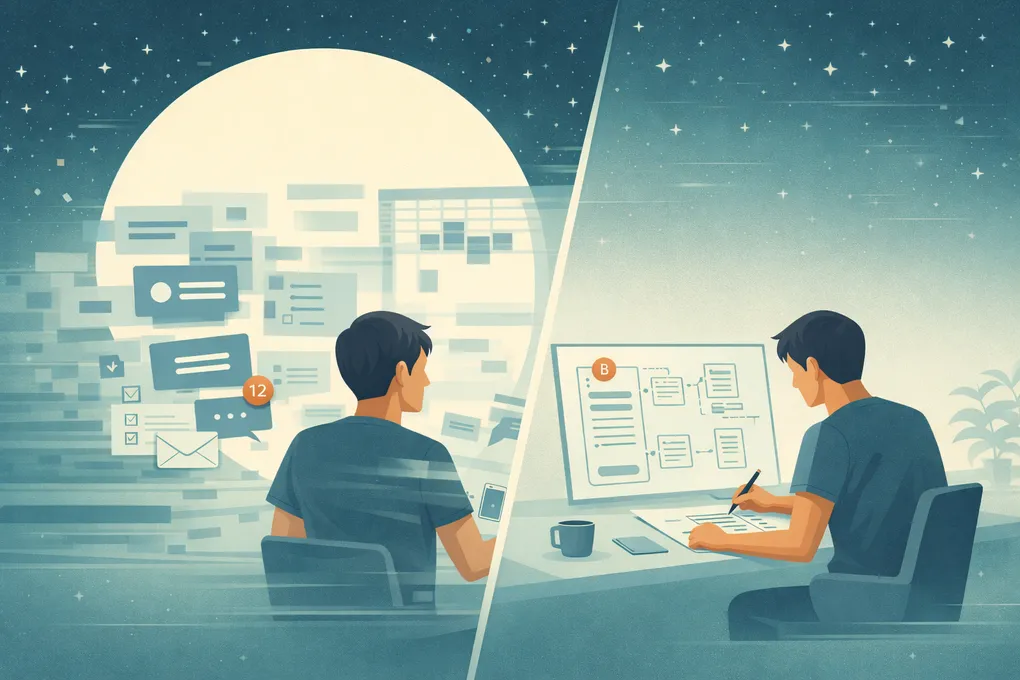
Why I Didn’t Get Into Product to Sit in Meetings
Most product managers do not choose this job because they dream of status updates, calendar Tetris, and five versions of the same alignment conversation.
They get into it because they want to understand customers, solve real problems, shape direction, and make better decisions.
Designers are not here for endless handoff loops either. Engineers usually do not wake up excited to spend half the week coordinating dependencies. We all say we want to work on the product. Then a surprising amount of the week gets swallowed by operational drag.
That is the gap AI makes interesting to me.
Not because it helps us move faster in some abstract way. Because it might give us more time back for the part of the work we actually care about.
The Problem With “AI = Speed”
Most AI conversations flatten into the same promise: write faster, code faster, research faster, ship faster.
I get why that framing catches on. It is simple. It demos well. It sounds measurable.
It is also incomplete.
The more useful question is this:
What should humans spend their time on now?
AI is genuinely good at a few things. It can process a lot of information quickly, summarize messy inputs, draft a first pass, compare patterns, and take repetition out of the system.
What it still does badly is the stuff that usually separates decent products from good ones: judgment, prioritization, taste, context, and deciding what actually matters.
If all you optimize for is speed, you can end up getting very efficient at making things that should not exist in the first place.
The Real Shift: Time and Attention
The shift is not really about tools. It is about where your time goes.
If AI takes some of the operational weight off the role, the valuable part of the role moves up, not down.
For PMs, that can mean less coordination and more strategy, judgment, and problem framing.
For designers, less repetitive production and more attention on interaction quality, product clarity, and decisions.
For engineers, less boilerplate and more energy for architecture, tradeoffs, and product thinking.
In theory, that is the good version of this story.
There is a catch.
The Trap: Faster at the Wrong Things
This is the part that worries me most.
AI makes it absurdly easy to produce more. More documents. More designs. More code. More ideas. More artifacts that look finished.
But more output is not the same thing as better outcomes. Sometimes it is just cleaner-looking confusion.
If direction is weak, AI helps you scale weak direction.
If your product thinking is shaky, AI helps you generate polished versions of shaky thinking.
That is how teams end up with better-formatted noise, faster roadmaps with fuzzy value, and a lot more visible activity without better decisions underneath it.
Speed amplifies what is already there. That is why this shift is not mainly technical. It is behavioral.
Roles Are Changing (But Not Disappearing)
There is a lot of talk right now about roles collapsing into each other. PMs becoming designers. Designers becoming engineers. Everyone becoming a builder.
There is some truth in that. The edges are blurrier than they used to be.
PMs can prototype more. Designers can work closer to systems. Engineers can contribute earlier to product decisions.
Still, I do not think the disciplines disappear. They exist for a reason.
Good products usually come from the tension between product thinking, design thinking, and engineering thinking. You want those perspectives pushing on each other a little. That tension is healthy.
What is changing is the range inside each role. The modern version of the job asks for more flexibility, more range, and more comfort working across boundaries.
That does not make craft less important. If anything, it makes it easier to notice when craft is missing.
What Actually Becomes More Valuable
When I look at my own work, the high-value skills are getting more human, not less.
I mean things like deciding what not to build, spotting the real problem under the noisy one, understanding tradeoffs, setting direction, and holding the quality bar when everyone is under pressure.
AI can help around those decisions. It can give you inputs, options, drafts, and synthesis.
It still does not make the decision for you.
In a strange way, that makes good judgment more important, not less. When the cost of producing an answer drops, the cost of choosing the wrong answer becomes more obvious.
What I Changed in My Own Workflow
I did not try to use AI everywhere. That approach gets noisy fast.
Instead I asked a smaller question:
Where am I spending time on work that does not require my best thinking?
That led to boring, practical changes more than dramatic ones. I started using AI for first drafts, summarizing inputs instead of manually stitching them together, structuring messy information faster, and cutting repetition where I could.
The point was never to crank out more output.
The point was to create space.
Space to think. Space to decide. Space to focus on the part that actually matters.
Lessons Learned
A few things feel pretty clear to me now:
- Speed without direction creates noise.
- Judgment becomes more valuable, not less.
- AI is only as good as the context you give it.
- Roles evolve, but craft still matters.
- Deep work does not survive by accident. You have to protect it on purpose.
None of this happens automatically.
If you do not change how you work, AI mostly helps you do more of the same, just with nicer formatting.
What You Can Do
You do not need some elaborate setup to start.
If you are early, pick one repetitive task from your week and use AI to reduce the effort there. Then pay attention to what that frees up. Do you actually use the time better, or do you just fill it with more admin?
If you are further along, get more explicit. Decide what you want to protect, whether that is judgment, strategy, deep thinking, or quality. Then decide what you are comfortable automating around it. Build simple workflows from there.
The important part is not the tool stack.
It is the intention behind how you use it.
Closing Thought
AI will not magically improve your work.
What it usually does is make your current way of working more efficient. That can be great, or it can be a problem, depending on whether your current way of working is actually worth scaling.
So the question I keep coming back to is:
Are you optimizing the right work?
The opportunity is not just to move faster.
It is to reclaim the part of the job that actually matters. That, to me, is the real skill shift.

Designing Bitcoin Savings for the Real World
The first Bitcoin purchase is no longer the main product problem. The harder challenge is designing a journey that helps different savers start simply, stay the course, grow with confidence, and protect what they build.

Bitcoin - The brand nobody built and everybody owns
Bitcoin has no CMO, no central owner, and no marketing budget — yet its symbol is recognized almost everywhere finance touches. A Bitcoiner looks at it through a brand lens.

I Got Hacked - Here Is What I Changed and Why I Sleep Better Now
I got hacked and it changed how I think about personal security. This is the framework I built — layered defenses, separated identities, and practical paranoia that works without making daily life unbearable.